By Alston B. Calderon, Psychiatric PA-C, MSPAP — Combat Veteran | Metabolic Psychiatry — October 27, 2026
A short walk after meals is not wellness folklore. It is one of the best-replicated, lowest-cost tools we have for postprandial glucose — and glucose spikes are mood spikes. Here is the actual literature, with sources.
Most people finish a meal and sit down. That is when the glucose wave hits — and that is when the brain pays the bill. Irritability. Fog. The 2 p.m. crash. The 9 p.m. “wired and tired.”
Contracting muscle after you eat pulls glucose out of blood without begging the pancreas for extra insulin. That is not a slogan. It is measured in randomized crossover trials, meta-analyses, and continuous glucose monitoring studies from 2013 through 2025. I use it in clinic before I reach for another prescription, because if your post-meal curve is a cliff, your mood will be too.
What Happens After You Eat
Carbohydrate and mixed meals raise blood glucose. Insulin rises to drive that fuel into muscle, liver, and fat. Sit still and muscle is not asking for glucose. Peak climbs. The crash that follows is a neurochemical event, not “just digestion.”
Repeated post-meal hyperglycemia is tied to worse insulin sensitivity, endothelial stress, higher cardiometabolic risk, and — clinically — the exact cluster I see in metabolic psychiatry: mood lability, anxiety that clusters after meals, afternoon cognitive slump, and wrecked sleep after a large dinner.
Walking changes the physics. Active muscle recruits GLUT4 transporters that do not require extra insulin. Glucose leaves the blood. Peak drops. Area under the curve shrinks. The brain gets a smoother fuel line.
1. Immediate 10-minute walk vs. delayed 30-minute walk — Hashimoto et al., Scientific Reports(2025)
Ritsumeikan University ran a randomized, crossover, counterbalanced trial in 12 healthy young adults. Three conditions after a 75 g glucose load: sit, walk 10 minutes immediately, or walk 30 minutes starting 30 minutes later.
2-hour glucose AUC: 15,607 (immediate 10-min) vs. 15,732 (delayed 30-min) vs. 16,605 mg·min/dL (sit)
Mean glucose: 127.9 vs. 128.9 vs. 135.8 mg/dL
Peak glucose: only the immediate 10-minute walk significantly cut the peak — 164.3 vs. 181.9 mg/dL sitting (p = 0.028, d = 0.731). The delayed 30-minute walk did not significantly blunt the peak (175.8 mg/dL, p = 0.184)
Translation I give patients: timing beats duration. If you miss the rise, you are mopping the floor after the spill. A short walk started now outperforms a longer walk started after the spike has already peaked.
2. After supper walk a mile — Engeroff, Groneberg & Wilke, Sports Medicine (2023)
Systematic review and meta-analysis of 8 randomized crossover trials, 30 interventions, 116 people (47 with type 2 diabetes, 69 without).
Exercise after the meal cut postprandial glucose vs. sitting (SMD 0.55, 95% CI 0.34–0.75) and vs. exercising before the meal (SMD 0.47, 95% CI 0.23–0.70)
Pre-meal exercise did not beat sitting for the post-meal curve (SMD −0.13, 95% CI −0.42 to 0.17)
The longer you wait after eating, the weaker the effect (time-to-exercise moderator p = 0.001)
Authors’ conclusion, not mine: walking has a greater acute effect on postprandial hyperglycemia when you start as soon as possible after the meal — not before, and not after a long delay.
3. Three 15-minute post-meal walks vs. one 45-minute walk — DiPietro et al., Diabetes Care(2013)
Still the cleanest 24-hour CGM study in older adults at risk for impaired glucose tolerance. Inactive people ≥60 with fasting glucose 105–125 mg/dL. Three protocols, 4 weeks apart.
Three 15-minute post-meal walks and one 45-minute sustained morning walk both improved 24-hour glucose vs. a no-walk control day
Post-meal walking was significantly better than a single 45-minute morning or afternoon walk at lowering 3-hour post-dinner glucose — the spike that wrecks the night
Dinner is the meal that usually wins. If you only walk once, walk after supper.
4. Advice to walk after meals in type 2 diabetes — Reynolds, Mann, Williams & Venn, Diabetologia (2016)
Free-living randomized crossover in adults with type 2 diabetes. Same total walking time: either 10 minutes after each meal or one 30-minute walk whenever. Specifying “walk after meals” produced better postprandial control than the same minutes without timing — especially after the evening meal.
5. Exercise “snacks” and breaking up sitting — 2023–2025 metas
You do not need a dedicated “workout” if the goal is the post-meal curve.
Gao et al., Nutrients 2023: postprandial exercise reduced glucose AUC (Hedges’ g −0.32) and 24-hour mean glucose (g −0.33) vs. control in people with overweight, obesity, or type 2 diabetes. Bigger 24-hour effect in T2D.
Walking interruptions beat standing. Light walking lowers post-meal glucose and insulin; standing is not a substitute.
2025 Frontiers in Nutrition meta of 17 trials in adults with obesity: interrupting sitting every ≤30 minutes with 2–5 minutes of light-to-moderate walking or simple resistance cut glucose iAUC (SMD −0.49) and insulin iAUC (SMD −0.26) vs. uninterrupted sitting.
Two to five minutes is not “nothing.” Use both tools: walk after meals, and break the sitting blocks in between.
6. What the popular press got right in 2026
National Geographic (Feb 2026) summarized this stack for a general audience: even gentle post-meal movement changes how the body and the gut-brain axis handle food. Yale’s Gerald Shulman’s line is the mechanism in one sentence — exercise can bypass defects in insulin signaling. DiPietro’s 15-minute walks and the 2025 10-minute immediate-walk trial sit behind that piece.
Why This Is a Mental Health Intervention
Metabolic psychiatry is not “exercise is good for you.” The brain is an energy organ on top of a metabolic system. Jagged post-meal glucose and insulin produce:
Mood instability. Rapid rise and crash feel like irritability, tearfulness, or sudden anxiety with no psychological trigger.
Anxiety that mimics panic. Adrenergic rebound after a crash is shakiness, heart rate, dread. Patients think they need a benzo. Sometimes they need a flatter curve.
Focus collapse. Neurons hate unstable fuel. Post-lunch fog is often postprandial, not a character flaw.
Sleep sabotage. A high dinner spike plus late sitting is the opposite of sleep hygiene. DiPietro’s dinner-specific finding is why I prescribe the evening walk first.
Gut–brain signaling. Meal-related vagal afferents influence satiety, interoception, anxiety, and mood. Movement after eating supports motility and that signaling loop. 2026 work in anxiety–depression also shows blunted postprandial gastric slow-wave responses and lower vagal HRV — the meal is not psychologically neutral.
Direct RCTs of “10-minute post-meal walks as an antidepressant” do not exist at the scale we have for glucose. What we do have is ironclad glucose data plus strong evidence that walking, vagal tone, and glycemic stability all move anxiety and mood. I treat the mechanism in front of me.
Physical Health Payoff
Insulin demand down. Muscle takes the glucose. Pancreas works less hard that hour.
24-hour curve, not just one spike. Split post-meal bouts beat a single workout for dinner and often for the whole day in older and diabetic cohorts.
Digestion. Upright walking aids gastric emptying versus slumping. Keep it easy — this is not a post-Thanksgiving 5K.
Blood pressure and sitting toxicity. Walking breaks beat standing breaks for glucose, insulin, and in older-adult trials, blood pressure.
Weight is downstream. This is a glucose-disposal protocol. Fat loss is a side effect of a better 24-hour fuel curve — not the primary endpoint of a 10-minute stroll.
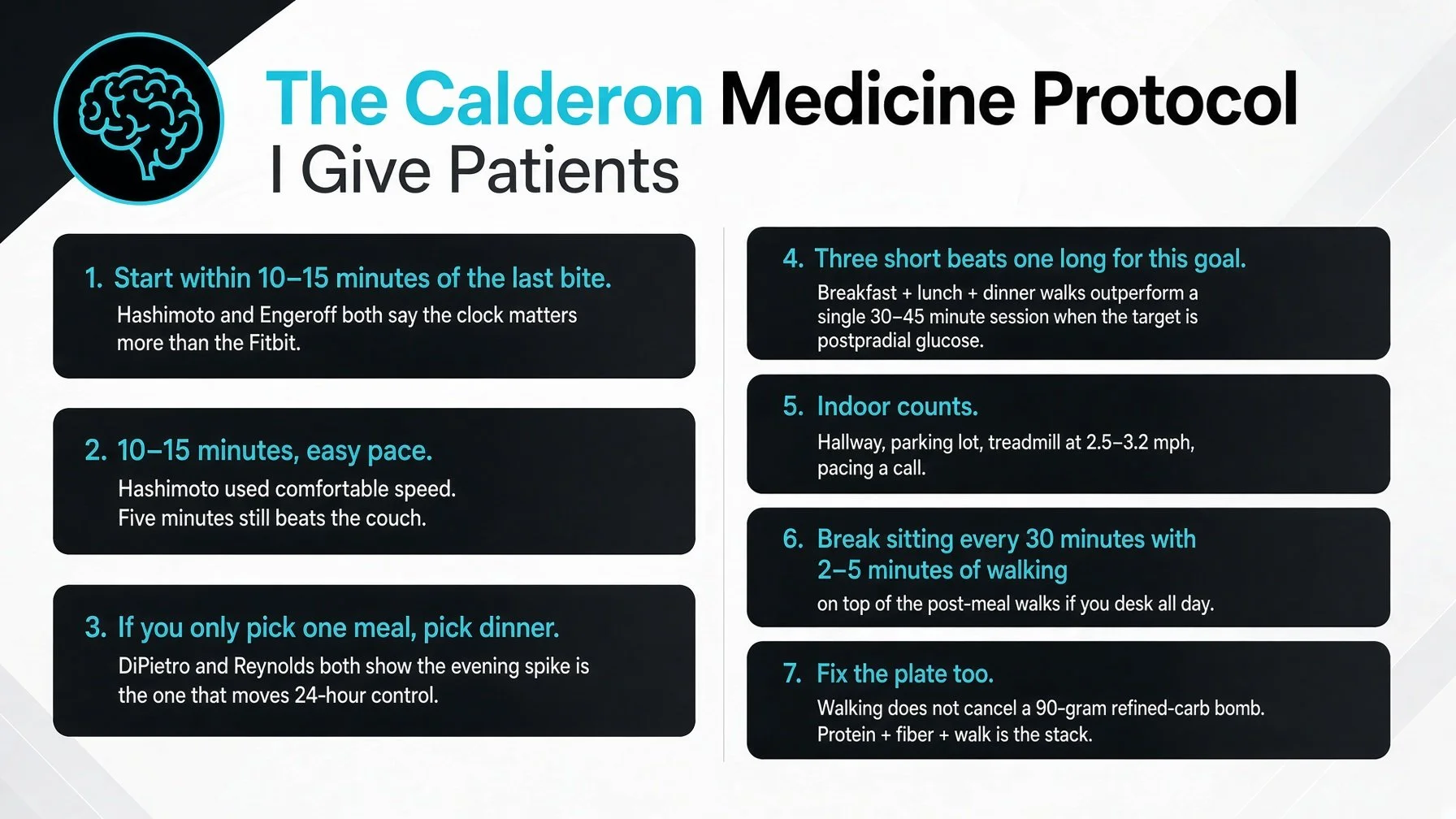
The Calderon Medicine Protocol
Who Needs This Yesterday
Prediabetes, PCOS, metabolic syndrome, or “labs are fine but I crash after lunch”
Anyone on antipsychotics, mood stabilizers, or other insulin-resistance-heavy meds
Anxiety that clusters after meals or late evening
Treatment-resistant depression with waist, triglycerides, fatty liver, or wrecked sleep
Desk-bound professionals, shift workers, veterans, first responders
What This Is Not
Not a replacement for treating diabetes, apnea, thyroid disease, or a psychiatric diagnosis that needs a full workup.
Not license to ignore protein, fiber, alcohol, or 11 p.m. grazing.
Not HIIT on a full stomach.
If you use insulin or a sulfonylurea, post-meal walking can drop glucose more than you expect. Check. Adjust with your prescriber.
Modify for uncontrolled angina, acute joint flares, post-op restrictions, or fall risk.
One 2024 meta comparing pre-meal vs. post-meal activity across mixed designs did not find a clean 24-hour winner on every endpoint. That does not erase the acute postprandial data. For the spike in front of you, after still beats before. For training adaptations over months, other timing can matter. Different question.
How We Use This at Calderon Medicine
In the virtual concierge practice this is not a PDF. Post-meal walking sits next to labs, sleep, protein targets, and — when indicated — ketogenic therapy, hormones, or medication rationalization.
A CGM makes the habit stick. Patients watch the spike flatten in real time. Behavior that shows a number survives Thursday. Behavior that is “good for you” dies by Thursday.
Start Tonight
Eat. Stand up. Walk ten minutes. That is day one.
Seven dinners. Watch sleep and next-morning mood. Then add lunch. Stop arguing about whether you have time. You had time to sit.
Mental health is not only what you think. It is what your mitochondria and your glucose curve are doing while you think. The papers are below. The walk is free.
Call Now (772) 202-2117 · Veterans / first responders / nurses 20% off.
References
Hashimoto K, Dora K, Murakami Y, Matsumura T, Yuuki IW, Yang S, Hashimoto T. Positive impact of a 10-min walk immediately after glucose intake on postprandial glucose levels. Sci Rep. 2025;15:22662. doi:10.1038/s41598-025-07312-y. https://www.nature.com/articles/s41598-025-07312-y
Engeroff T, Groneberg DA, Wilke J. After dinner rest a while, after supper walk a mile? A systematic review with meta-analysis on the acute postprandial glycemic response to exercise before and after meal ingestion. Sports Med. 2023;53(4):849-869. doi:10.1007/s40279-022-01808-7. PMID: 36715875. https://pubmed.ncbi.nlm.nih.gov/36715875/
DiPietro L, Gribok A, Stevens MS, Hamm LF, Rumpler W. Three 15-min bouts of moderate postmeal walking significantly improves 24-h glycemic control in older people at risk for impaired glucose tolerance. Diabetes Care. 2013;36(10):3262-3268. doi:10.2337/dc13-0084. PMID: 23761134. https://pubmed.ncbi.nlm.nih.gov/23761134/
Reynolds AN, Mann JI, Williams S, Venn BJ. Advice to walk after meals is more effective for lowering postprandial glycaemia in type 2 diabetes mellitus than advice that does not specify timing. Diabetologia.2016;59(12):2572-2578. doi:10.1007/s00125-016-4085-2. PMID: 27665923. https://pubmed.ncbi.nlm.nih.gov/27665923/
Gao Y, et al. Efficacy of postprandial exercise in mitigating glycemic responses in overweight individuals and individuals with obesity and type 2 diabetes — a systematic review and meta-analysis. Nutrients.2023;15(20):4489. doi:10.3390/nu15204489. https://www.mdpi.com/2072-6643/15/20/4489
Acute effects of exercise snacks on postprandial glucose and insulin metabolism in adults with obesity: a systematic review and meta-analysis. Front Nutr. 2025;12:1708301. doi:10.3389/fnut.2025.1708301. PMID: 41356824. https://pubmed.ncbi.nlm.nih.gov/41356824/
Yates T, et al. Metabolic effects of breaking prolonged sitting with standing or light walking in older South Asians and White Europeans: a randomized acute study. Walking breaks lowered postprandial insulin, glucose, and blood pressure; standing did not. https://pmc.ncbi.nlm.nih.gov/articles/PMC6909896/
Solomon TPJ, et al. The effect of preprandial versus postprandial physical activity on glycaemia: meta-analysis of human intervention studies. Diabetes Res Clin Pract. 2024;210:111638. doi:10.1016/j.diabres.2024.111638. PMID: 38548105. https://pubmed.ncbi.nlm.nih.gov/38548105/
A walk after eating can change how the brain and body respond to food. National Geographic. February 2026. Commentary from Gerald Shulman (Yale) and Loretta DiPietro. https://www.nationalgeographic.com/health/article/walking-after-meals-health-benefits
Décarie-Spain L, Hayes AMR, Lauer LT, Kanoski SE. The gut-brain axis and cognitive control: a role for the vagus nerve. PMC10427741. https://pmc.ncbi.nlm.nih.gov/articles/PMC10427741/
Postprandial attenuation of gastric slow waves in anxiety–depression, with and without functional dyspepsia: associations with heart rate variability and sleep quality. Front Med. 2026. https://www.frontiersin.org/journals/medicine/articles/10.3389/fmed.2026.1890716/full
Educational only. Not medical advice. Work with a qualified clinician before changing activity or diet if you have diabetes, take glucose-lowering meds, or have a psychiatric diagnosis.