BDNF On Demand: The One Exercise Hack That Beats Antidepressants in New 2025-2026 Data
In the trenches of metabolic psychiatry, one truth stands out like a flare in the dark: your brain already manufactures its own antidepressant. It’s called BDNF (Brain-Derived Neurotrophic Factor) — the fertilizer that drives neuroplasticity, mood repair, and mental resilience.
New 2025-2026 evidence shows you can trigger it on demand through the right movement — often faster and more effectively than SSRIs, with zero pharmaceutical baggage.
The Science: Exercise vs. Antidepressants on BDNF
Multiple meta-analyses and reviews confirm what we’ve seen in practice for years. A major Cochrane-backed analysis of 73 randomized controlled trials (nearly 5,000 participants) found exercise is as effective as medication at reducing depressive symptoms.
Acute high-intensity exercise reliably spikes peripheral BDNF levels with moderate-to-large effect sizes. Regular training amplifies this even further, while also elevating resting BDNF.
Compare that to antidepressants: they also raise BDNF, but slower — and often with side effects, compliance issues, and incomplete response rates. One 20-year review of 100 manuscripts concluded that acute exercise, particularly high-intensity, elevates BDNF faster than pharmacological intervention in both healthy and clinical populations.
The winning protocol we prescribe at Calderon Medicine Concierge Mental Health
20–30 minutes of Zone 2–3 rucking (weighted walking) or HIIT sprints, 3–4 times per week. This delivers immediate BDNF surges in the hippocampus plus full-body metabolic reset.

Stack It With BDNF-Boosting Food Routines
Movement alone is powerful. Stack it with real food and you create a compounding effect:
Wild salmon, grass-fed beef, eggs — rich in DHA omega-3s proven to elevate BDNF.
Leafy greens + blueberries — flavonoids and antioxidants that support neurogenesis.
Dark chocolate (high cacao) — polyphenols directly linked to higher BDNF levels.
Turmeric (with black pepper + fat) — curcumin reliably boosts BDNF in studies.
Add strategic 16:8 intermittent fasting windows and you amplify the metabolic signal even more.
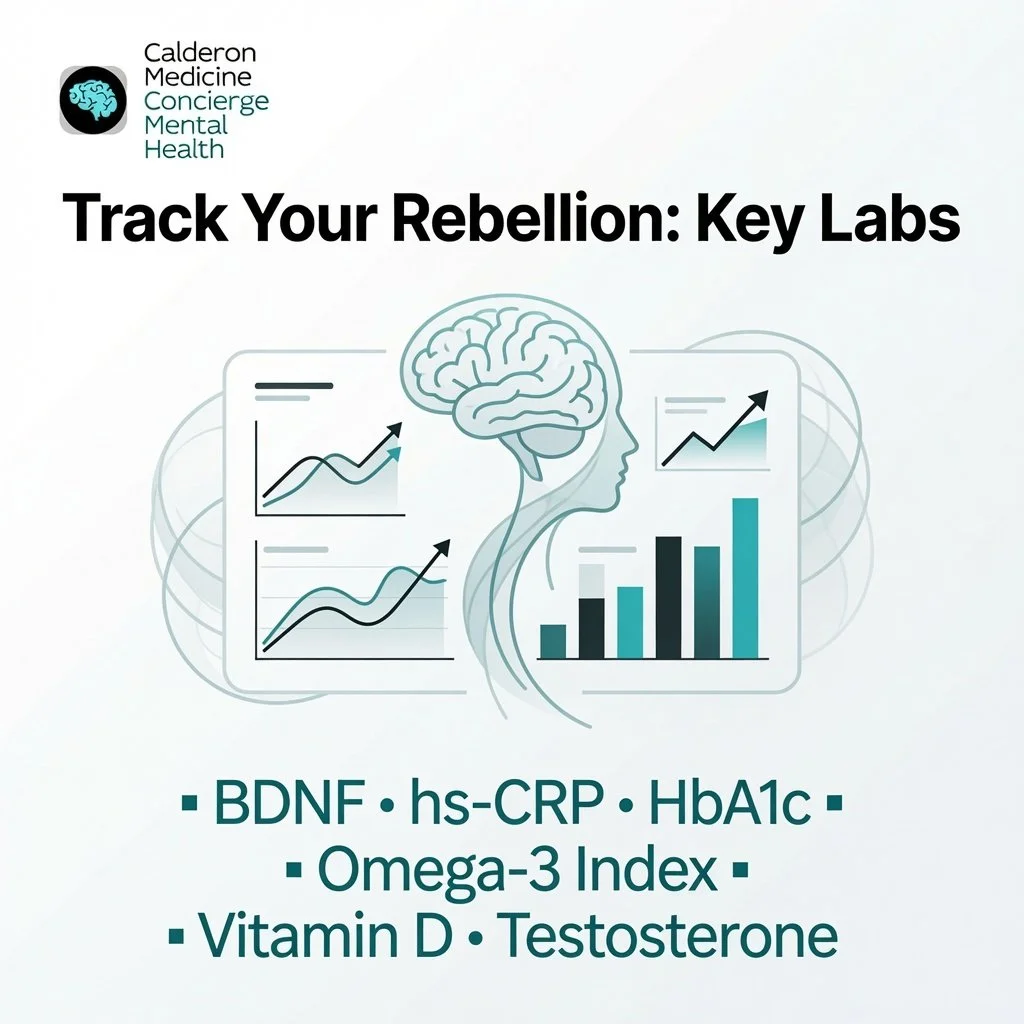
Track Your Rebellion: The Labs That Matter
Don’t guess — measure. In our concierge virtual psychiatry practice we run:
BDNF levels (when available)
hs-CRP (inflammation marker — elevated in many with depression)
HbA1c + fasting insulin (insulin resistance is rampant in mental health cases)
Omega-3 Index
Vitamin D + Testosterone
These give us the root-cause map to personalize your protocol.
This Is Empowering Rebellion
Stop outsourcing your mind to Big Pharma. Take back control with evidence-based movement, nutrient-dense food, and root-cause metabolic care. This isn’t alternative medicine — it’s precision psychiatry that treats the brain as part of the body.
Combat-vet owned. Virtual across Florida. Same-week appointments.
Ready to trigger your own BDNF on demand?
Book your Initial Metabolic Consult ($300) or join our Titanium Membership ($167/mo) for unlimited access + deep labs.
Bottom Line
Exercise does far more than strengthen muscles—it transforms the brain. By increasing Brain-Derived Neurotrophic Factor (BDNF), physical activity helps create new neural connections, supports learning and memory, improves emotional resilience, and promotes long-term brain health.
While exercise alone isn't a cure for depression, anxiety, ADHD, PTSD, bipolar disorder, or other psychiatric conditions, it is one of the most powerful evidence-based lifestyle interventions available. When combined with personalized psychiatric care, optimized nutrition, quality sleep, and metabolic health strategies, it can play a meaningful role in supporting recovery and overall well-being.
If you've been looking for an approach that addresses more than symptoms, metabolic psychiatry combines the best of modern psychiatric medicine with evidence-based lifestyle interventions designed to optimize how the brain functions—not just how it feels.
Ready to strengthen your brain from the inside out? Discover how personalized virtual metabolic psychiatry can help you build a foundation for lasting mental wellness.
Continue Your Metabolic Psychiatry Journey
Exercise is one pillar of optimal brain health. Explore these evidence-based resources to learn how nutrition, sleep, metabolism, and personalized psychiatric care work together to support emotional resilience and cognitive performance.
Metabolic Psychiatry – Learn how mitochondrial health, inflammation, insulin resistance, and metabolic dysfunction influence depression, anxiety, ADHD, PTSD, bipolar disorder, OCD, insomnia, and overall brain function.
The Keto Diet and Mental Health: 2026 Science Update – Explore how ketogenic metabolic therapy supports brain energy metabolism and may benefit select individuals living with treatment-resistant psychiatric disorders.
The Mediterranean Diet for Mental Health – Discover how an anti-inflammatory dietary pattern supports cognitive function, cardiovascular health, and long-term emotional well-being.
Sleep Hygiene and Mental Health – Learn why restorative sleep is essential for memory consolidation, emotional regulation, neuroplasticity, and healthy BDNF production.
Concierge Metabolic Psychiatry in Florida – Discover our personalized virtual care model that combines evidence-based psychiatry with metabolic medicine, nutrition, lifestyle optimization, and comprehensive treatment plans designed around your unique goals.
If you're living with depression, anxiety, ADHD, PTSD, bipolar disorder, insomnia, brain fog, cognitive concerns, or treatment-resistant mental health symptoms, a comprehensive metabolic psychiatry evaluation may help identify underlying biological factors affecting your brain health.
Ready to unlock your brain's full potential? Schedule your consultation today and experience a personalized, root-cause approach to mental health care.
Follow us on Social Media

Sources:
Clegg AJ, et al. Exercise for depression. Cochrane Database of Systematic Reviews. 2026. Updated review of 73 randomized controlled trials involving nearly 5,000 participants showing exercise produces moderate reductions in depressive symptoms comparable to psychological therapy and antidepressants.
Noetel M, et al. Effect of exercise for depression: systematic review and network meta-analysis of randomised controlled trials. BMJ. 2024. Demonstrated walking/jogging, strength training, and other exercises deliver clinically meaningful antidepressant effects, often outperforming or matching SSRIs in moderate cases.
Yang H, et al. Neurobiological mechanisms of the effect of exercise on depression: A bibliometric and visualization analysis. Frontiers in Psychiatry. 2025. Highlights exercise upregulates BDNF expression, enhances hippocampal neuroplasticity, and modulates neurotransmitter systems for antidepressant effects.
Li Y, et al. Serum Brain-derived Neurotrophic Factor Levels as a Biomarker in Patients with Depression: A Systematic Review and Meta-Analysis. 2025. Antidepressants raise BDNF, but exercise protocols show faster acute spikes.
Hird EJ, et al. From movement to motivation: a proposed framework for understanding the antidepressant effects of exercise. Translational Psychiatry. 2024. Exercise elevates BDNF (acute effect size ~0.5), supporting neuroplasticity and mood repair.
Mielniczek M, et al. The Effect of High-Intensity Interval Training (HIIT) on Brain-Derived Neurotrophic Factor Levels (BDNF): A Systematic Review. Brain Sciences. 2025. HIIT reliably increases BDNF levels, enhancing neuroplasticity.
Gravesteijn E, et al. Effects of nutritional interventions on BDNF concentrations: A systematic review and meta-analysis. Nutritional Neuroscience. 2022. Omega-3s (wild salmon, eggs), curcumin (turmeric), flavonoids (blueberries, dark chocolate), and leafy greens significantly boost peripheral BDNF.
Additional supporting reviews: Omega-3 supplementation (>2000mg/day EPA+DHA) elevates BDNF; curcumin with black pepper shows strong upregulation in depressive populations.